Take Control of Data Quality Before It Controls Your Business
Qualytics infers 95% of your data quality rules from observed data behavior and continuously adapts as that behavior changes. Yourteams guide governance with business context, delivering broad coverage without the manual effort that limits most programs.

How the Platform Works
Profile & Understand Data
Understand your data, day one.
Qualytics gives teams a trustworthy day-one view of data structure and behavior.
The platform scans every container and field, then unifies structural and behavioral metadata into Field Profiles that establish a day-one baseline and refresh continuously as data changes. Teams find hidden issues in hours, not weeks, and prevent downstream rework. Segmented profiling breaks results out by tenant, region, segment, or any dimension, exposing issues that only surface in a slice of the data.
Profile every record to identify field types, formats, nullability, cardinality, and structural patterns, giving you an accurate understanding of how data is really structured
Learn expected behavior by observing distributions, ranges, volumes, and relationships over time, establishing historical norms that drive anomaly detection, and supports inferred rules and thresholds
Consolidate structural and behavioral metadata into unified Field Profiles and store them so teams can analyze trends and track data quality across systems over time
Automatically break profiles down by tenant, region, segment, or any dimension you choose
“We have a 239M row consumer dataset with 4,000 columns, with a lot of hidden issues we didn’t know about until we automated data profiling.”
Create & Maintain Rules
Scale coverage without scaling headcount.
In that same lakehouse, real coverage requires tens of thousands of quality rules, just for critical fields. If each rule takes about an hour to align with subject matter experts, implement, test, promote to production, and document, the upfront effort exceeds 30,000 engineer-hours. Thousands more hours are required every year as 10 to 20 percent of schemas and business definitions change. No organization can staff that. Coverage stays thin. Teams fall back into reactive rule management.
Qualytics delivers high rule coverage on day one, without manual overhead.
Proprietary AI models auto-suggest about 95 percent of rules needed from training on your actual data, delivering immediate coverage for advanced technical and foundational business rules. From there, business subject matter experts extend coverage with guided low-code and no-code rule authoring for sophisticated business logic, while engineers can still write full-code rules for highly specialized edge cases. Coverage and maintenance scale with change and configuration, not headcount.
Advanced machine learning turns profiling metadata and observed behavior into suggested rules and thresholds for reliable day one coverage. You choose how deep to go with suggested rules by layer or dataset, because Bronze, Silver, and Gold layers require different quality dimensions to be prioritized. In Qualytics, that control is built in through a simple slider
A guided low-code and no-code UI lets business and data teams co-own rule creation and maintenance without advanced SQL skills. Start fast with 50+ prebuilt, production-ready data quality rules spanning common patterns from simple validations to complex reconciliations
Turn any rule into a reusable template, then apply it across datasets and systems with a single, centrally governed configuration. This keeps standards consistent, prevents duplicate rule building, and ensures teams always know what is enforced where
Test new or updated rules safely against production data before promotion. Dry runs show expected pass/fail rates and example anomalous records, helping teams calibrate thresholds and avoid noisy alerts in production
“I have two people full-time manually writing and maintaining over a thousand rules, which is inefficient and not scalable for our business.”
Monitor & Validate Quality
Move from manual checks to continuous validation.
A lakehouse often uses a medallion architecture, processing hundreds of millions of events per day from bronze to silver to gold. Hundreds of transformations compound risk. Even a 1–2 percent weekly regression rate creates join mismatches, casting errors, and logic changes. One small change in bronze can ripple into incorrect metrics in gold, with no hard failure to flag it.
Qualytics detect anomalies continuously, before issues spread downstream.
The platform monitors structural and behavioral signals as data moves through stages of pipelines and schemas, tracking schema drift, volumes, key metrics, and distributions in near real time. Issues are detected closer to the source and inside pipelines, before bad data is stored or spreads downstream. Teams see what changed, where it changed, and which downstream assets are at risk. Human review of anomalies closes the loop, and feedback continuously improves detection over time.
Track anomaly status, ownership, severity, and resolution metadata in one place, creating a clear operational record from detection through closure
Track metric and volume trends over time and alert on deviations from historical norms, surfacing partial loads, spikes, regressions, or outages that row-level checks miss
Stewards review anomalies, label outcomes, and provide feedback that continuously refines rules and detection through supervised learning over time
Enable collaborative monitoring by managing configuration, validation runs, and anomaly workflows through a unified UI or programmatically via APIs, helping teams operate the way they work best
“The team currently relies on visual tracing tools for root cause and impact analysis downstream but the lack of an automated, scalable process is a significant financial risk.”
Notify & Remediate Issues
Turn alerts into prioritized responses.
Hundreds of rules can generate thousands to millions of alerts per day across multiple tools. Many are redundant, lack ownership, or provide no impact context. Teams re-run analysis to find offending records while noise buries the critical issues. Alerts bounce between engineering and subject matter experts with no clear path to resolution. By the time an issue is remediated, it is often too late.
Qualytics turns alerts into prioritized remediation before data issues become business issues.
Every alert includes ownership, severity, impact, and explainable context that pinpoints what changed and the exact offending records. No-code Flows route incidents to the right stewards and can trigger remediation workflow through Jira or ServiceNow, or notify teams in Teams or Slack. Flows can also halt data propagation in pipelines by pausing jobs or gating promotion steps. Actions and affected records are captured in the Enrichment Datastore, creating a governed audit trail that speeds resolution and reduces risk.
Assign clear owners and lifecycle status to each anomaly giving teams clarity on who is responsible, who is working on it, and what is resolved
Enrich anomalies with explainable context, including anomaly weight, failed rules, and affected source records, making severity clear and preventing critical issues from getting buried in noise
Orchestrate governed remediation through Flows and integrations, storing affected records and resolution context in the Enrichment Datastore to create an auditable trail from anomaly to fix
“Alerts don't matter if we're not getting the right people to proactively handle the anomaly and remediate the issues.”
Frequently Asked Questions
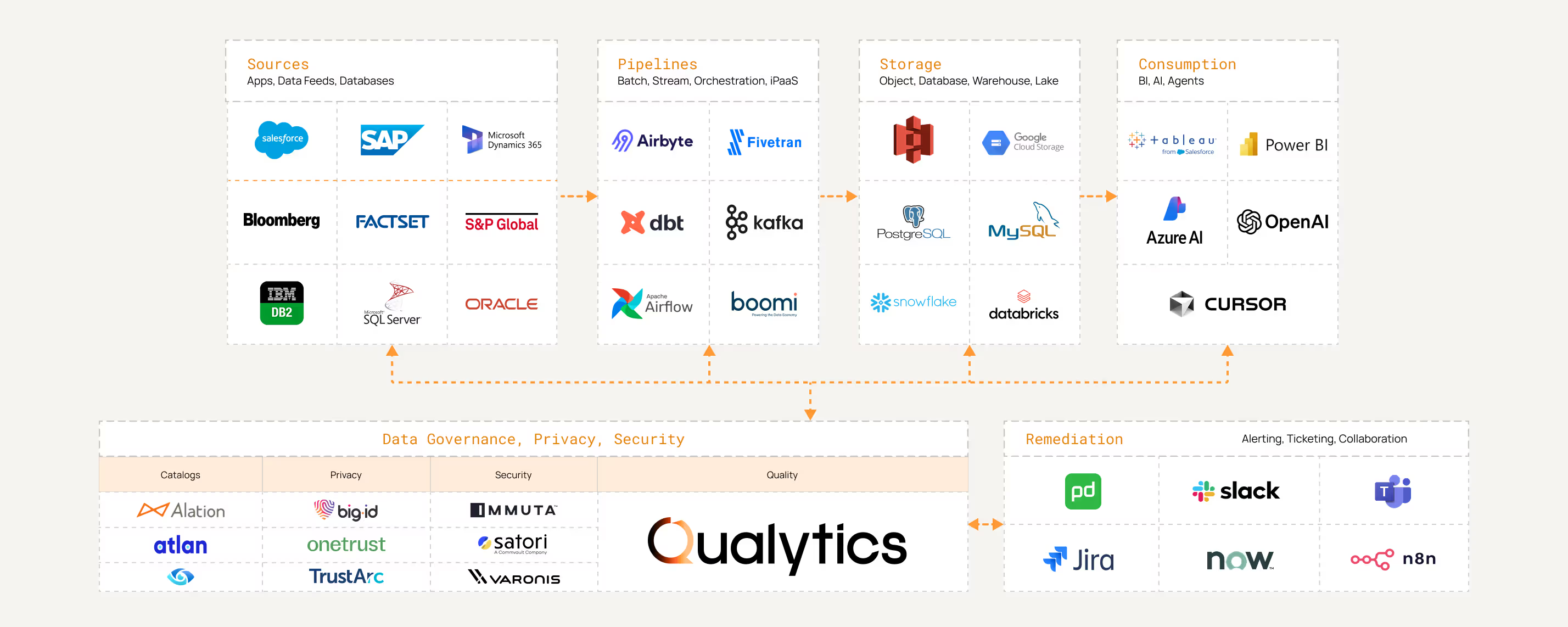
Qualytics supports any SQL data store and raw files on object storage. Popular data warehouses such as Snowflake, Databricks, Redshift; popular databases such as MySQL, PostgreSQL, Athena, Hive, along with CSV, XLSX, JSON and other files on AWS S3, Google Cloud Storage and Azure Data Lake Storage are a few examples of supported data stores. Users can also integrate Qualytics to their streaming data sources through our API.
Qualytics is architected with enterprise-grade scale in mind, and built on Apache Spark and deployed via Kubernetes. Through vertical and horizontal scalability, Qualytics meets enterprise expectations of high volume and high throughput requirements of data quality at scale.
Qualytics never stores your raw data. Raw data is pulled into memory for analysis and subsequently destroyed – anomalies identified are written downstream to an Enrichment datastore maintained by the customer. Highly-regulated industries may choose to deploy Qualytics within their own network where raw data never leaves their network and ecosystem.
A dedicated Customer Success Manager, with mandatory weekly check-ins.
Qualytics supports both modern solutions and legacy systems:
Modern Solutions: Qualytics seamlessly integrates with modern data platforms like Snowflake, Amazon S3, BigQuery, and more to ensure robust data quality management.
Legacy Systems: We maintain high data quality standards across legacy systems including MySQL, Microsoft SQL Server, and other reliable relational database management systems.
For detailed integration instructions, please refer to the quick start guide.
Qualytics automatically profiles data, infers quality rules and thresholds, detects anomalies, initiates remediation workflows, and adapts to data changes without requiring manual reconfiguration.
Yes, Qualytics’s metadata export feature captures the mutable states of various data entities. You can export Quality Checks, Field Profiles, and Anomalies metadata from selected profiles into your designated enrichment datastore.
Quality Scores measure data quality at the field, container, and datastore levels, recorded as a time series to track improvements. Scores range from 0-100, with higher scores indicating better quality.

Ready to take control of your data quality?
Learn how to automate and scale anomaly detection across your data environment.